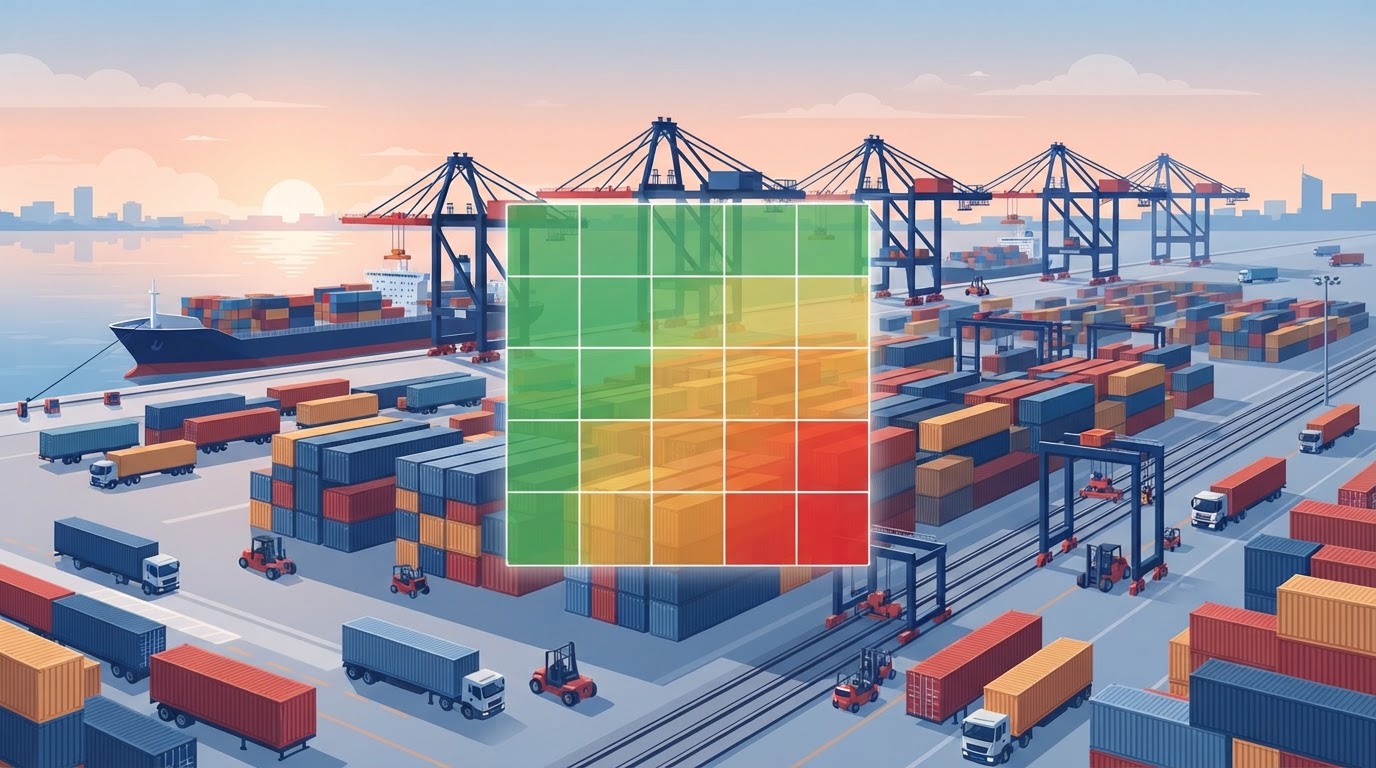
Customs risk scoring helps officers rank inspections. Customs scores each risk on two scales, how likely it is and how serious the harm would be, then multiplies the two to get a priority from 1 to 25. Officers therefore address the highest scores first. The one exception matters just as much: a rare risk with a catastrophic consequence must stay near the top, even when its score looks modest.
Why customs cannot inspect everything
Customs risk scoring helps busy ports prioritise checks across thousands of declarations each day. If officers opened every container, trade would stall and honest traders would pay for it in delay and cost. If they inspected almost nothing, revenue, safety and security would suffer. Therefore, risk-based customs control sits between these two failures: spend scarce inspection effort where the expected harm is highest, and let low-risk trade move quickly.
However, that approach works only if “highest risk” has a clear meaning. Customs risk scoring provides that definition. As a result, officers can turn differing opinions into an inspection priority list that managers can defend, repeat and review. Moreover, this process forms one step in the wider risk management cycle described in our guide to ISO 31000 risk management.
Step 1: use customs risk scoring for likelihood and consequence
First, estimate two things for every identified risk.
- Likelihood: how probable is it that the event happens? Use evidence where you have it: past seizures and audit findings, the hit rates of existing profiles, results of random checks, intelligence, and trends in trade volumes.
- Consequence: how serious is the damage if it does happen? Consider revenue lost, harm to health and safety, security impact, environmental damage, harm to legitimate business, and damage to the reputation of customs and government.
For example, customs risk assessment often uses a five-point scale for each factor: 1 means rare or minor, while 5 means almost certain or catastrophic. Multiply the two numbers. For instance, likelihood 4 multiplied by consequence 5 gives 20, a high priority. By contrast, likelihood 2 multiplied by consequence 2 gives 4, a low priority.
Step 2: interpret the customs risk matrix
Next, plot each risk on a grid with likelihood on one axis and consequence on the other. Officers then divide the customs risk matrix into three zones, each with a clear action rule.
| Zone | Typical meaning | What customs does |
|---|---|---|
| High (red) | Intolerable against the risk appetite | Immediate treatment: a profile, targeted controls, or joint action with other agencies |
| Medium (amber) | Tolerable with care | Planned treatment and regular monitoring |
| Low (green) | Within appetite | Accept, monitor, and release quickly |
The thresholds in a customs risk scoring matrix depend on each administration’s criteria and risk appetite. As a result, two customs services may reasonably draw their red zones differently. Therefore, the administration should document and approve each boundary instead of leaving decisions to individual officers.
Worked example: customs risk assessment for six scenarios
For example, imagine a port customs office whose risk committee has six items on its table. This risk assessment helps compare inspection priorities. Importantly, the scores below illustrate teaching judgments rather than real statistics. Another committee might reasonably choose different scores.
| Risk | Likelihood | Consequence | Score |
|---|---|---|---|
| Undervalued tyres from new importers | 4 | 3 | 12 |
| Counterfeit spare parts in express parcels | 3 | 4 | 12 |
| Seized fertiliser stored in an old warehouse | 2 | 5 | 10 |
| Wrong origin claimed for preferential duty | 4 | 2 | 8 |
| Wildlife products hidden in transit containers | 2 | 4 | 8 |
| Typing errors in optional statistical fields | 4 | 1 | 4 |
This customs risk scoring example shows why totals need context. If officers rank risks by score alone, the fertiliser store comes third. However, a risk committee should give this hazard higher priority. Its likelihood is low, but if it goes wrong the consequence is a disaster, not a revenue loss. By contrast, officers can accept and monitor the last item, which scores 4. Inspecting it extensively would delay legitimate trade with little benefit.
Step 3: estimate expected loss in customs risk assessment
For revenue risks, customs risk scoring can also incorporate an estimate of monetary exposure. Expected loss is the number of transactions, times the probability of non-compliance, times the average duty at stake per case.
For example, consider the undervalued tyres. Suppose 6,000 declarations a year, a 5% chance that a declaration is undervalued, and an average duty gap of US$900. That is 6,000 × 0.05 × 900 = US$270,000 at risk. Consequently, this estimate helps managers compare revenue risks and explain requests for additional resources to a finance ministry.
However, use the figure with care. When evidence is limited, structured expert assessment gives a more reliable basis for customs risk decisions than false precision.
When a low customs risk score still demands action
Nevertheless, a low customs risk score does not always mean a low priority. On 4 August 2020 a fire at the port of Beirut set off about 2,750 tonnes of ammonium nitrate that authorities had stored in a hangar since 2014. The blast killed more than 200 people, injured thousands and destroyed much of the port and nearby neighbourhoods. Customs officials repeatedly asked the judiciary to decide whether to re-export or sell the cargo. However, no decision followed, and the material remained there for about six years.
Therefore, this case offers two lessons for anyone using a customs risk register. First, a low-likelihood risk with a catastrophic consequence deserves special attention precisely because it rarely happens and therefore feels safe to ignore. Second, when several agencies share responsibility, no single agency may take ownership of the risk. Customs teams should therefore record seized, abandoned and hazardous goods under their control in the risk register. Each entry needs an owner with the authority and duty to act.
Common customs risk scoring mistakes
- Ranking by score only. Instead, require the committee to review every risk with consequence 5, whatever its total score.
- Scoring from gut feeling. Tie each likelihood level to evidence such as hit rates and audit findings, and record the evidence.
- Ignoring the cost to honest traders. A profile that stops many clean consignments scores badly on facilitation even if it catches a few offenders.
- Never rescoring. Furthermore, teams should use every inspection result to inform the next customs risk assessment. Without regular updates, a risk register gradually becomes a historical record.
- No owner. As the Beirut example shows, agencies may overlook risks when nobody owns the response.
How to introduce risk-based customs controls
- Begin customs risk scoring by listing your top 15 risks across revenue, security, health, environment and trade integrity.
- Agree what each number on the two five-point scales means, in plain words and with evidence sources.
- Score the list in a small group first, then compare scores and discuss every difference larger than one point.
- Draw the matrix, mark the red, amber and green zones, and have the director approve the zone boundaries.
- Name an owner and a treatment (avoid, reduce, share or accept) for every red and amber risk.
- Review the customs risk scores quarterly using inspection and audit results.
Frequently asked questions
Is a 5 × 5 matrix the only way to score customs risk?
No. Some administrations use 3 × 3 or 4 × 4 grids, and some add quantitative models. The five-point version is popular because it is simple to explain and fine enough to separate priorities.
What is the difference between a risk score and a profile?
A customs risk score ranks threats to guide inspection priorities. By contrast, a customs profile targets consignments linked to a selected risk, using indicators such as origin, goods and trader history.
How often should customs risk scores be reviewed?
Many customs risk committees meet monthly or quarterly. However, review customs risk scores sooner after a major seizure, changing trade patterns or new regulations.
Can small customs offices use this method?
Yes. A spreadsheet, a short list of risks and a monthly meeting are enough to begin. Above all, consistent risk scoring matters more than the software.
In addition, the World Customs Organization Risk Management Compendium explains how assessment, selectivity and targeting support customs decisions.
Go deeper
Finally, remember that customs risk scoring is one chapter of a full customs risk management system: profiling, control channels, compliance models and monitoring. Our five-day Customs Risk Management and Trade Facilitation course takes you through the whole chain with case studies and exercises. If your work leans towards audits, see also our article on risk-based audits.
اقرأ هذا الموضوع بالعربية: تقييم المخاطر الجمركية: كيف تقرر الجمارك أي شحنة تُفتَّش أولاً.