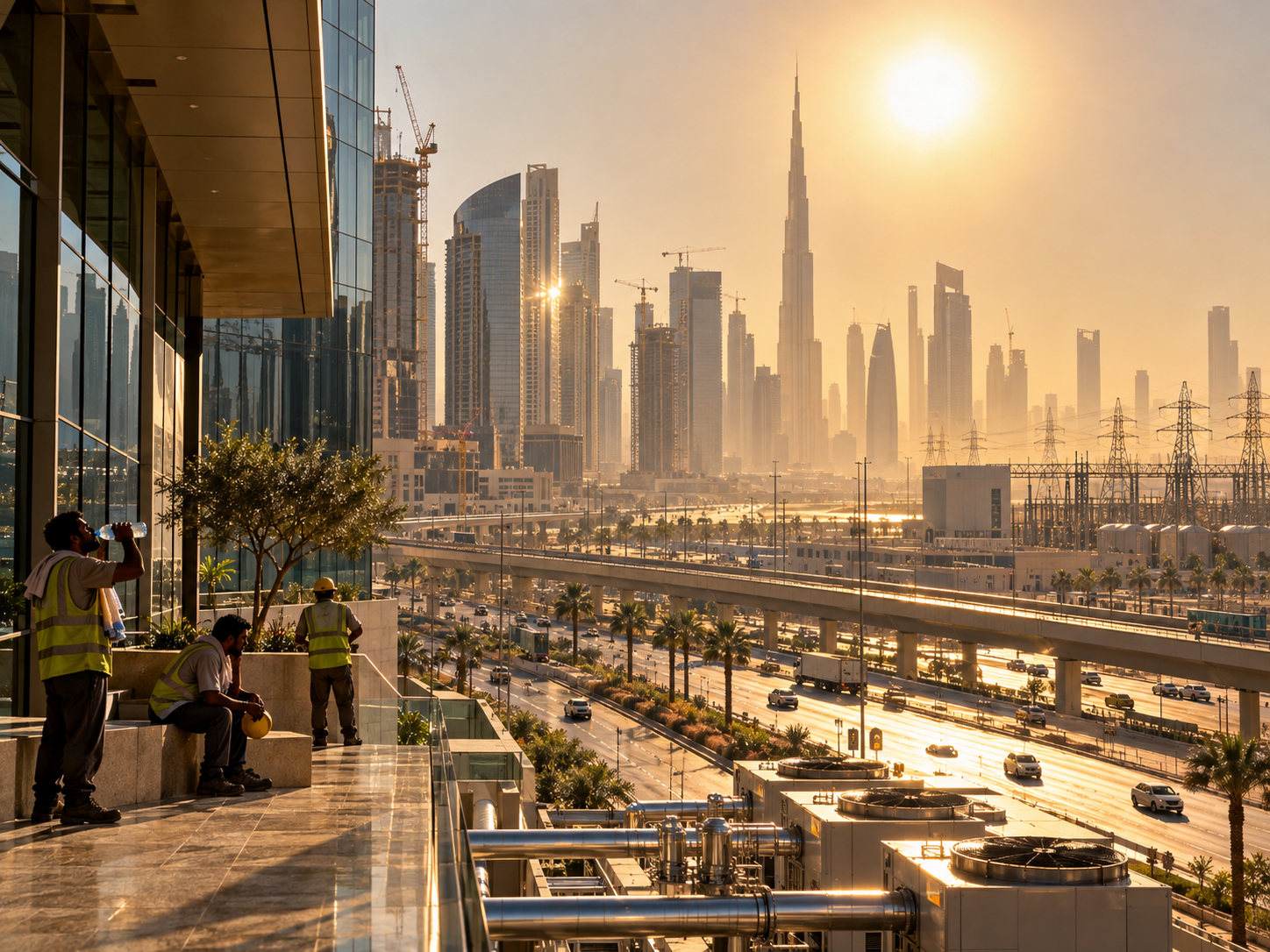
What happens to an economy when 2 p.m. becomes too hot to work normally? In many regions, extreme heat is becoming a major concern for the workforce.
The first effects are easy to imagine. Outdoor work slows, workers need more recovery time, and buildings use more electricity to stay cool. Yet these are only the most visible consequences.
Extreme heat can also change project schedules, transport patterns, healthcare demand, tourism activity, supply chains and operating costs. A company may remain open and a city may continue to function, but both can become less productive and more expensive to operate.
That is why extreme heat is no longer only a climate issue. It is increasingly an economic and operational issue. This is the idea behind the 50°C economy.
The term does not mean that 50°C is a universal safety threshold. Heat risk also depends on humidity, direct sunlight, air movement, workload and individual health. Instead, the phrase captures a broader question:
What happens when businesses and cities designed for yesterday’s climate have to operate in hotter conditions?
Extreme Heat Is Already Affecting Business
The economic impact is no longer theoretical. A 2026 World Bank study covering the Middle East, North Africa, Afghanistan and Pakistan found that three in ten firms operate in extreme heat for more than 100 days each year. The same research linked around 17 additional days of extreme heat per year with a 6% fall in sales, a 4% decline in labour productivity and an 8% reduction in wages, according to the World Bank.
These figures matter because a business does not need to close before heat starts costing money. A construction company may complete less work in a day, a warehouse may need more cooling to maintain normal conditions, and a delivery network may have to change its schedules. Hotels may spend more on electricity, while factories may see workers slow down before any formal shutdown is required.
The effect often appears gradually through higher energy bills, lower output, project delays, worker fatigue and additional maintenance. Heat is therefore moving from the weather forecast into normal business planning.
How Extreme Heat Changes Productivity and the Working Day
One of the most difficult aspects of heat-related productivity loss is that it can be almost invisible.
A worker may still arrive on time. A warehouse may still operate. A driver may still finish the route. Yet the same task can take longer, require more rest or involve a higher risk of mistakes.
WHO and WMO guidance on workplace heat stress reports that worker productivity can decline by around 2% to 3% for every degree above 20°C under the heat-stress measure used in the research, according to WHO and WMO.
This creates a practical measurement problem. Most organizations measure attendance, working hours, absenteeism and output, but far fewer consider whether an hour worked during severe heat produces the same amount of value as an hour worked under normal conditions. An eight-hour shift may still appear as eight hours on a timesheet, while the available productive capacity is lower. That distinction matters for staffing plans, project schedules and budgets.
How Extreme Heat Could Reshape Working Hours
Extreme heat may also change something even more fundamental: when economic activity happens.
Some physically demanding work may need to move earlier in the morning or later into the evening. Maintenance teams may increasingly operate at night, tourism activities may shift towards cooler hours, and deliveries may be rescheduled to avoid the hottest part of the day. These changes do not happen in isolation.
Earlier construction starts may require suppliers to deliver earlier as well. Tourism moving into the evening could lead restaurants, transport services and retail businesses to extend their operating hours. Night-time maintenance would also change staffing, supervision and security arrangements. Heat can therefore become a coordination problem across an entire city.
For Gulf economies that are simultaneously expanding construction, tourism, transport, aviation and entertainment, that question could become increasingly important. The challenge is not simply keeping workers cool. It is keeping interconnected systems synchronized while working hours begin to shift.
Cooling and Heat Resilience Are Becoming Essential Infrastructure
Air conditioning is usually treated as part of a building. In hot economies, however, cooling is starting to look more like essential infrastructure.
The International Energy Agency reports that cooling already accounts for about one-quarter of annual electricity demand in the Middle East and North Africa and almost half of peak electricity demand. It is also expected to remain one of the region’s main drivers of electricity-demand growth.
This creates a difficult cycle. As temperatures rise, businesses need more cooling to continue operating normally, yet the hottest periods are precisely when electricity systems face some of their greatest pressure. The consequences extend far beyond office comfort.
Hospitals depend on stable temperatures for patients, staff and medical equipment. Airports depend on cooling across terminals and support facilities. Hotels, shopping centres, warehouses, data centres and schools also rely heavily on uninterrupted electricity and temperature control. In these environments, a cooling failure can quickly become an operational failure.
The conversation therefore moves beyond simply installing more air-conditioning units. It begins to include building efficiency, insulation, backup power, maintenance, energy management and the resilience of the electricity grid itself. For professionals responsible for these systems, Agile Leaders’ Mastering The Art of Facilities Management Training Course (10 Days) covers HVAC efficiency, energy benchmarking, building maintenance, sustainability and operational resilience.
In a hotter economy, cooling is not simply comfort. It helps make economic activity possible.
Cities Are Becoming Heat-Management Systems
Extreme heat also changes the way cities need to be understood. The temperature shown on a weather app does not tell us exactly how heat is experienced at street level. Shade, trees, road surfaces, building materials, traffic and urban density can all influence how hot a neighbourhood feels.
That means city design can affect economic activity directly. A street with very little shade may discourage walking during large parts of the day, which can reduce activity for nearby shops and restaurants. Poorly insulated buildings require more electricity to stay comfortable. Hotter transport infrastructure can make commuting more difficult and increase the pressure on public services.
In other words, decisions that once appeared mainly architectural or environmental can have economic consequences.
In 2026, the UN Environment Programme (UNEP) launched the 50@50 initiative, bringing together more than 50 cities to strengthen heat preparedness and test how urban systems respond to rising temperatures. Lagos is among the participating cities.
The question for cities is therefore changing. It is no longer only about how to respond when a heatwave arrives. Increasingly, it is about how transport, public spaces, buildings, healthcare and commercial activity can continue to function when severe heat becomes more common.
Extreme Heat Across Construction and Global Supply Chains
Construction is one of the sectors most visibly exposed to extreme heat.
Workers often combine physical effort with direct sunlight, hot surfaces and protective clothing. Even when work continues, productivity can decline and additional recovery time may be required. For major projects, relatively small daily losses can accumulate.
A delay at the construction stage may affect contractors, financing costs and the final handover date. If the project is an airport, hotel, transport link or large real-estate development, those delays can then affect businesses and customers waiting for the asset to become operational.
The original issue may be extreme heat, but the eventual consequence becomes a project-management and financial problem.
This is particularly relevant across the GCC, where large infrastructure, real-estate and tourism projects continue to form an important part of economic development.
A company does not need to operate in extreme heat to experience its effects; sometimes the exposure sits elsewhere in the supply chain.
Research reported by Reuters in September 2026 found that heat stress was reducing annual revenues by an average of 4.1% in affected Bangladeshi garment factories. The research also suggested that practical measures, including better ventilation, insulation and reflective paint, could recover their costs within four years.
A retailer in Dubai, a manufacturer in Saudi Arabia or a distributor in Nigeria may depend on suppliers operating thousands of kilometres away. If those suppliers lose production capacity because of heat, the buyer may experience longer lead times, higher prices or lower stock levels. Heat resilience can therefore become part of supply-chain resilience.
This could eventually change the questions procurement teams ask suppliers. Cost and quality will remain important, but climate exposure, cooling capacity and operational continuity may become increasingly relevant as well.
Healthcare Faces Pressure From Both Sides
Healthcare shows how extreme heat can affect several systems at once. High temperatures can increase cases of dehydration, heat exhaustion, heatstroke and other health problems, according to WHO.
At the same time, hospitals depend heavily on cooling, electricity, transport, emergency services and staff availability. This creates a double pressure: more people may need care at exactly the moment when the infrastructure supporting healthcare is under greater strain.
A hospital therefore cannot prepare for extreme heat through healthcare planning alone. Its resilience also depends on energy supply, transport access, facility management and emergency planning.
The same idea applies elsewhere. Airports, hotels, data centres and warehouses all depend on several systems working at the same time.
Extreme heat can expose what happens when one of those dependencies becomes weaker.
Tourism May Need a Different Clock
Tourism in hot destinations has always been seasonal, but extreme heat could increasingly change not only which months attract visitors, but also which hours of the day economic activity takes place.
Destinations may rely more heavily on evening events, indoor attractions, shaded public spaces and climate-controlled transport. Restaurants, retail businesses and entertainment venues may extend their activity later into the night.
This possibility is particularly relevant for Gulf economies investing heavily in tourism, hospitality, aviation and entertainment.
It raises an interesting question:
Could part of the future tourism economy increasingly operate after sunset?
If it does, the effects would spread well beyond tourist attractions. Transport schedules, staffing patterns, security, retail opening hours and electricity demand could all change.
Extreme heat may therefore alter not just where economic activity happens, but when.
Heat Eventually Reaches the Balance Sheet
Climate discussions often become easier to understand when they are translated into money.
- Lower productivity can increase labour costs because more time is required to produce the same output.
- Project delays can increase contractor and financing costs.
- Greater cooling demand can raise electricity bills.
- Worker illness can increase absence and reduce available capacity.
- Supply-chain disruption, tourism shifts and equipment stress can raise inventory, maintenance and delivery costs.
At that point, extreme heat becomes relevant to finance teams, project managers, procurement specialists, operations managers, facility managers, insurers and investors.
Some organizations may already be paying for heat without identifying it as a separate risk. The cost may appear under energy, overtime, maintenance, insurance, project contingencies or lost productivity.
That makes measurement important: if organizations cannot see where heat is already affecting their costs, it becomes difficult to decide where adaptation investment would produce the greatest return.
The 50°C Economy Is Creating New Markets
The story is not only about risk. Extreme heat is also creating demand for new products and services.
The World Bank estimates that the market for cooling solutions across the MENAAP region could reach around US$46 billion by 2050.
That opportunity extends beyond traditional air conditioning. Demand could grow for better insulation, energy-efficient buildings, cool roofs, heat-monitoring systems, urban shading, resilient construction materials, facility-management services and more efficient energy systems.
This changes the way adaptation can be viewed. For governments and businesses, adaptation represents a cost because infrastructure needs to change, but for companies capable of delivering those solutions, it also represents a growing market.
The 50°C economy will therefore create both new risks and new commercial opportunities.
What Should Businesses Look at Now?
Organizations do not need to wait for record-breaking temperatures before examining their exposure. A practical starting point is to identify where heat already affects normal operations.
- Which roles and facilities face the greatest heat exposure?
- Which activities become slower during the hottest hours?
- Which operations cannot continue without reliable cooling or power?
- Which projects or suppliers are most vulnerable to prolonged heat?
- What happens if severe heat coincides with a power outage, transport disruption or equipment failure?
These questions make heat easier to treat as a measurable business-continuity risk rather than an abstract climate concern.
The Real Question Is Not How Hot It Gets
The usual question is:
How high will temperatures go?
For businesses and cities, there is a more useful question:
What stops working when they do?
That question changes the entire conversation. Heat becomes a workforce issue when productive capacity falls and an energy issue when cooling demand rises. Delayed schedules turn it into a project risk, while supplier capacity problems make it a supply-chain concern. When cities struggle to maintain normal activity, the challenge becomes one of infrastructure resilience.
Eventually, it becomes a financial issue. The systems supporting modern economies were designed around assumptions about normal temperatures, working hours, energy use and human productivity. Those assumptions are beginning to change.
The organizations and cities that adapt best may not be the ones that predict the hottest day most accurately. They may be the ones that understand exactly what depends on that day being normal and begin preparing before it is not.
References
World Bank. Competing in the Face of Climate Risks: Evidence from Firms and Policy Priorities in MENAAP. 2026.
(World Bank)
World Health Organization and World Meteorological Organization. Climate Change and Workplace Heat Stress: Technical Report and Guidance. 2025.
(WHO)
International Labour Organization. Tripartite Experts Agree on Measures to Protect Workers and Enterprises from Weather-Related Risks. 2026.
(ILO)
International Energy Agency. The Future of Electricity in the Middle East and North Africa.
(IEA)
United Nations Environment Programme. 50 Cities for Climate Action: Avoiding and Adapting to a 50°C World. 2026.
(UNEP)
Reuters. Costs to Cool Bangladesh Garment Factories Can Be Recovered Within Four Years, Study Shows. 20 September 2026.
(Reuters)